How to look at a primary source
A primary source is something written or made at the time. The links on our pages take you to the real ones.
They can look strange. You’ll find old books, old spellings and lots of small print. You don’t have to read it all.
What to do
- Find the line we used. Each episode’s page tells you where it is, and a word to search for. On a phone, use Find on page. On a computer, press Ctrl and F, or Command and F on a Mac.
- Look at one thing. It might be the date, or who wrote it. It might be a spelling that looks old.
- Ask your own question. Don’t take what it says at face value. That means: don’t believe it just because it’s old, or because someone wrote it down. Ask how the writer could know. Then ask how else you could find out.
- Stop there, or keep going. It’s enough to look at the one source. If you’re feeling curious, have a look at more of it.
What you’ll see when you open a link
- An old book, as plain text
- Some of our links go to the Internet Archive. A computer took a photo of each page of an old book, then read the words. You see the words it read, as one long page. It makes mistakes. In Henry of Huntingdon’s history, it read “from” as “fix)m”.
- A book typed up by people
- Project Gutenberg has whole books, typed up by volunteers. Pepys’s diary is there, as one very long page.
- A museum or university page
- Howard Carter’s diary is on the website of the Griffith Institute, at the University of Oxford. You can see a photo of each page in his own handwriting, with the words typed out beside it.
- An old text in two languages
- A website called Perseus has Herodotus in his own Greek, and in English. The two pages have the same section numbers, so you can find the same sentence in both.
- Wikipedia
- People write Wikipedia today, so it isn’t a primary source. It’s a good place to start. The small numbers in square brackets lead to where it got its facts.
Sources you can see as they were made
A typed copy shows you the words. These show you the page itself: the ink, the handwriting, the crossings-out. Open one, and look for the thing we point to.
Howard Carter’s journal, 1922
Carter wrote his journal by hand, on squared paper. On page 35 he writes down Lord Carnarvon’s question, “Can you see anything”, and his answer: “Yes, it is wonderful.”
Look for: the word “Snake” in the margin, with a circle round it and a line to where it goes. Then find two words he crossed out: “the furniture”.
Carter’s journal, at the Griffith Institute. Click the small picture of a page to see it big.
The tomb robbers’ confession, about 1110 BC
This papyrus is more than 3,000 years old. It records the trial of the tomb robbers, and their confession. It is written in hieratic, a quick way of writing ancient Egyptian. Long ago, someone cut it in half, probably to sell the two halves for more money. In 1935, an Egyptologist in Brussels called Jean Capart found one half rolled up inside a wooden statue.
Look for: the four long columns of writing.
The papyrus, at the Global Egyptian Museum. The photos are small, and taken through glass.
Samuel Pepys’s diary, in his own shorthand
Pepys wrote his diary in shorthand, a way of writing fast with signs instead of letters. To most of us it looks like squiggles. But he wrote names and places in full, in ordinary letters.
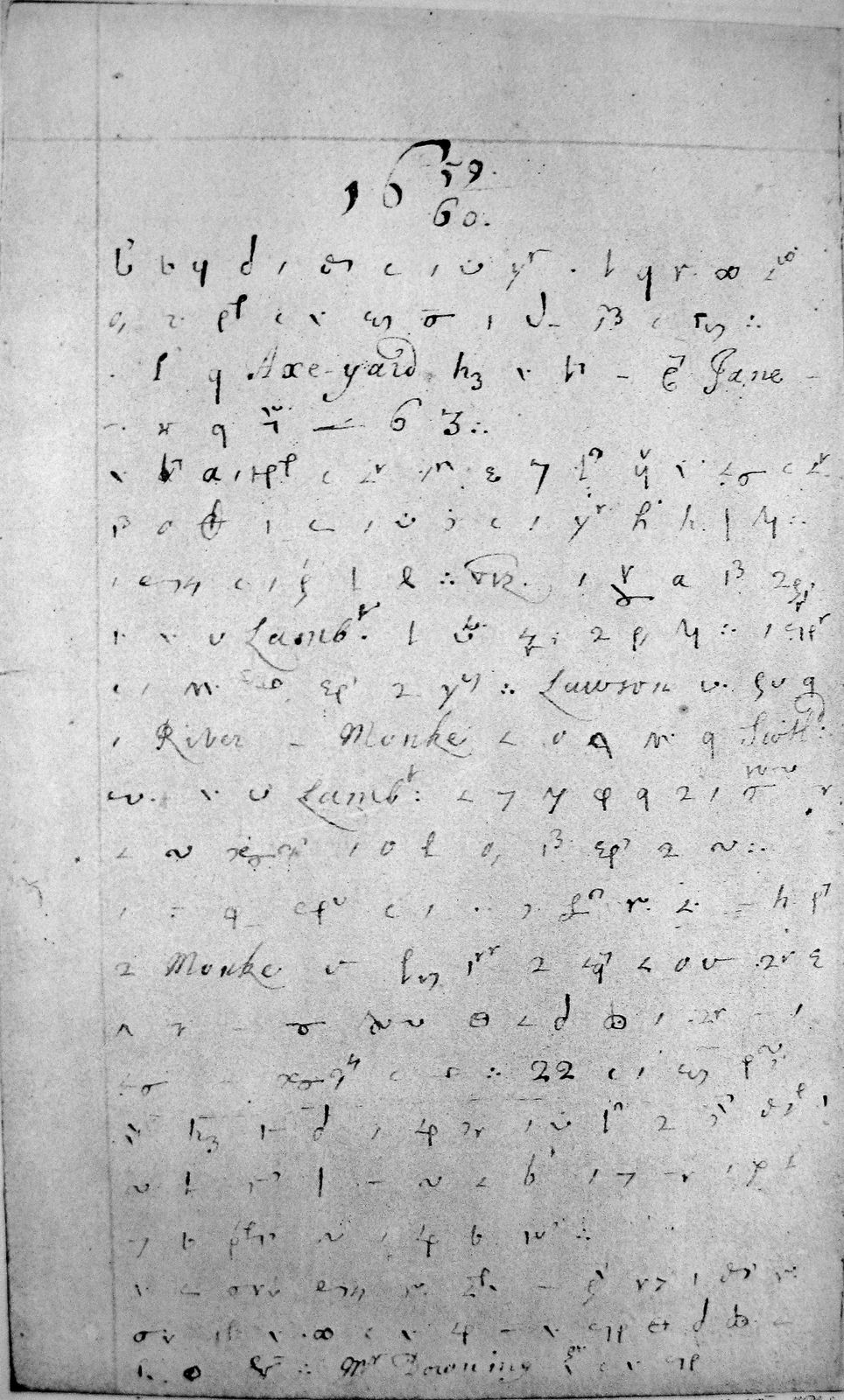
Look for: the words in ordinary letters on this first page. “Axe-yard” and “Jane” are near the top. His first entry says, “I lived in Axe Yard, having my wife, and servant Jane”.
Magdalene College in Cambridge keeps the diary. On its website you can see the page for 2 September 1666, the day the Great Fire of London began. On the fourth line, find “pigions”. That’s how Pepys spelled pigeons: “the poor pigions I perceive were loath to leave their houses”. The Great Fire page, at Magdalene College.
Merlin’s dragons, from the 1400s
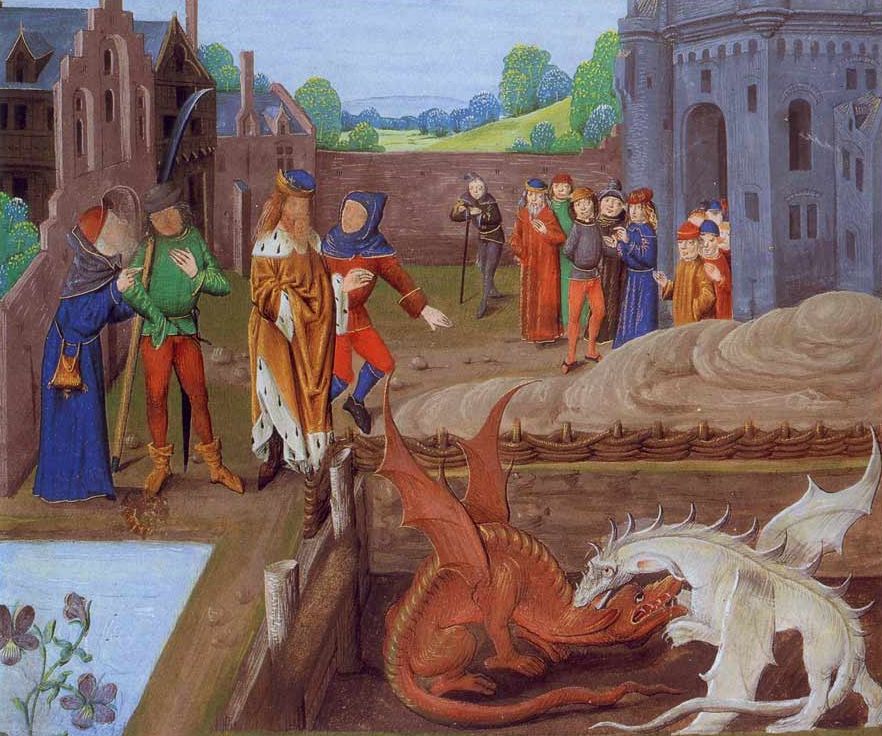
Geoffrey of Monmouth wrote his story of Merlin nearly 900 years ago. This picture was painted hundreds of years later, in a history called the St Albans Chronicle. So it isn’t Geoffrey’s own book. It’s someone else telling his story again.
Look for: the red dragon and the white dragon fighting in the pit, and the king in his crown, watching.
The picture, bigger, on Wikimedia Commons.
Herodotus: a copy of a copy
Nobody has the book Herodotus wrote himself. What we have are copies of copies. One of the oldest was written out by hand in the 900s, more than 1,300 years after he died. It’s in a library in Florence, in Italy.
Look for: the big red and gold letter at the start, and a red word at the top: ΚΛΕΙΩ. That’s Clio, the name of a Muse. Herodotus’s history has nine books, and each is named after one of the nine Muses.
The copy, at the Laurentian Library. Go to the 11th picture to see the first page.
What looks strange, and why
Old spellings
People spelled words differently in the past. Pepys wrote “Stonage” for Stonehenge, and “Abebury” for Avebury. He also wrote “shewed” for showed.
Mistakes by the computer
When a computer reads an old page, it gets some letters wrong. In James Henry Breasted’s book, the computer read his little half-brackets as letters, so the word “mask” came out as “rmaski”. If a word looks like nonsense, the computer probably misread it.
Translations
Some writers wrote in another language. What you read is a translation, so ask who translated it, and when. Herodotus wrote the Greek word for natron, a kind of salt. A. D. Godley’s English, from 1920, says “saltpetre”, which today usually means a different salt.
Brackets and dashes
Breasted turned an Egyptian papyrus into English. Where a word on the papyrus was lost, he put a dash. Where he wasn’t sure of a word’s meaning, he put it in half-brackets. He explains these signs at the front of his book. To find his key, search for “TYPOGRAPHICAL”.
Square brackets mean different things in different places. In Pepys’s diary, they hold notes from the book’s editors. On William of Newburgh’s page, they number the paragraphs. On Perseus, they number the sections. So look for what they mean before you trust them.
Footnotes
A footnote is a small note at the bottom of a page. It often starts with a star, like this: *. In Henry’s history, a footnote tells you where the Peak is: “In Derbyshire.” In Geoffrey’s history, a footnote from 1848 says part of his story “is untrue”.
A page number in the middle of a sentence
In a scanned book, the line at the top of each page comes in among the words, with its page number. In Carter’s book, the words “142 THE TOMB OF TUT ANKH AMEN” split the word “anxiously”, just before Lord Carnarvon’s question. That just means a new page has started: page 142.
What historians and other scholars do with the same source
- They read the whole thing.
- They ask their own questions about it, and don’t take what it says at face value.
- They compare copies and translations, to see where they differ.
- They check who wrote it, and when.
- They mark what is missing or unsure, as Breasted did with his dashes and brackets.
- They do their own research. They look for other evidence that agrees or disagrees: other writers, letters, pictures, and things people have dug up.
Here’s how that works. In episode 1, Henry wrote that nobody knew what Stonehenge was for. Archaeologists didn’t stop at his words. They dug at Durrington Walls, about 2 miles away, where the people who built Stonehenge probably lived. They found more than 38,000 animal bones, and most were from pigs. The pigs’ teeth showed that many were about nine months old. Piglets were most probably born in spring, so those pigs were killed in midwinter. So people probably gathered there for feasts in midwinter. Henry left a question, and the archaeologists found part of the answer by digging.
If you find one line, and ask who wrote it, when, and whether they were there, you’ve done the same kind of thing. If you ask your own question, and look for another source to check it against, you’re doing what scholars do.
How to check a source: the three questions See it for real: free places to goThe links on our pages go to other websites. Ask a grown-up before you visit them.