
Episode 3: Who really ran from Marathon?
Listen
0:00 / 16:09


In this version, Will’s lines are an AI copy of his voice. He will record them himself.
Your real score
If you like it, give us five stars wherever you listen. Here, give us your real score, and we’ll try to get it up.
Out of 10.
The sources behind this episode
Every source in this episode is real, and most are free to read online. Each card shows what this episode took from it.
Word hunt
Each source has something in it this episode had no time for. Open the source, find the word on the card, then come back and tap “I found it” to see what we left out.
If the page doesn’t jump to the word, search for it. On a computer, press Ctrl+F, or Cmd+F on a Mac. On a phone, choose Find on Page from the browser’s menu.
You’ve found 0 of 6 words.
The Homeric Hymn to Pan
An old Greek song about Pan, in Hugh Evelyn-White's English of 1914, on the Perseus Digital Library. Free to read.
In this episode
What Pan is like: the god of the wild and of shepherds, with a goat's legs and horns.
Open the hymnWord hunt: find this word in the source
nurse
What we had no time for. When Pan was born, with goat's feet, two horns and a full beard, his nurse was so scared she ran away. His father, Hermes, wrapped him in hare skins and carried him off to Zeus.
Herodotus: the charge at Marathon
Herodotus's Histories, book 6, written less than seventy years after the battle, in A. D. Godley's English, on the Perseus Digital Library. Free to read.
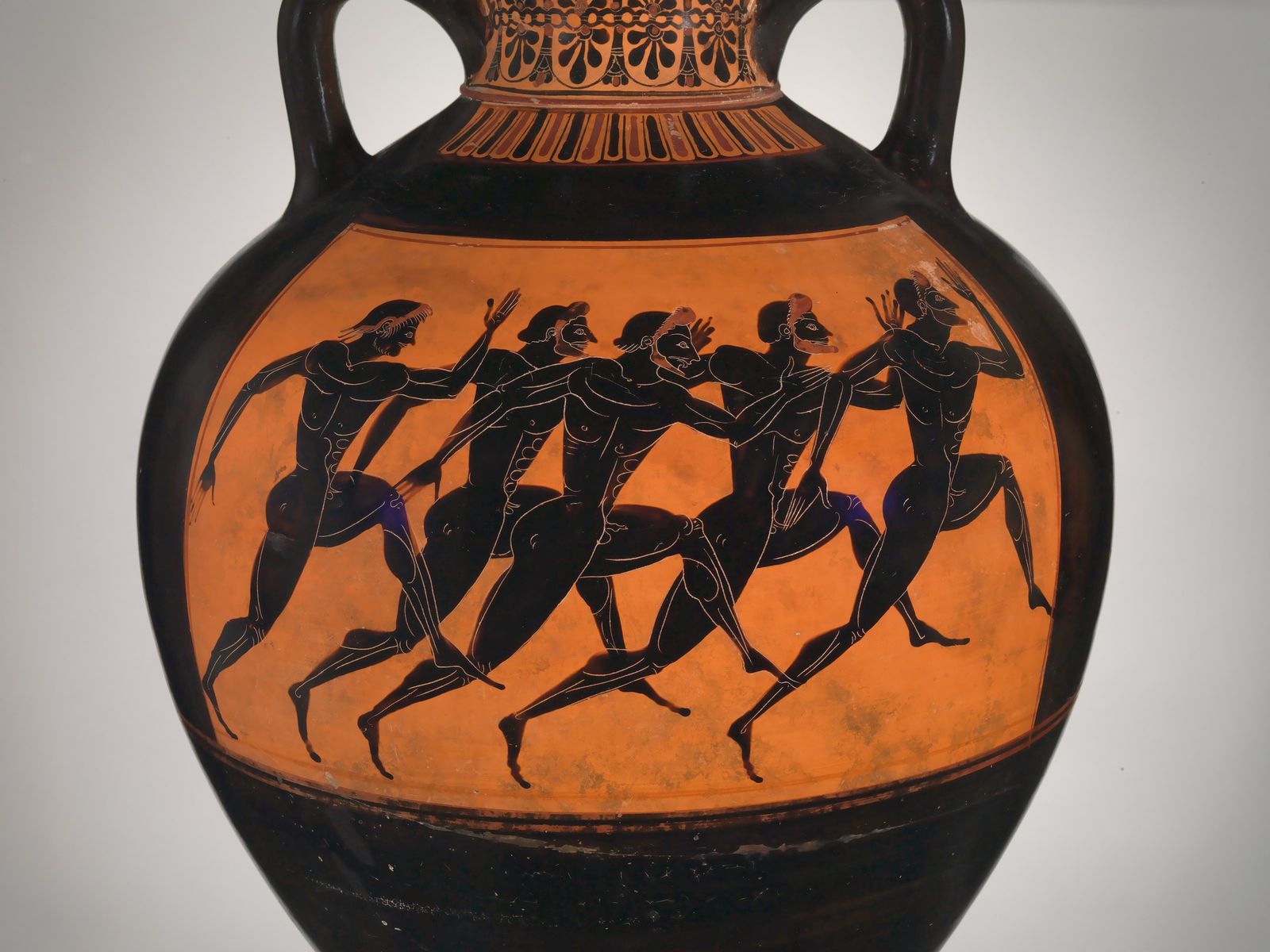
In this episode
The Athenians charging at a run, and the Persians thinking they were crazy. The picture is a Greek prize jar showing a footrace.
Open HerodotusWord hunt: find this word in the source
Median
What we had no time for. Herodotus says the Athenians were also the first Greeks who dared to look at the Persians' clothes. Before then, just hearing the name of the Medes, as Greeks called the Persians, made Greeks panic.
Herodotus: what Epizelus saw
The same book of Herodotus, a few pages on, about a soldier who fought at Marathon.
In this episode
Epizelus, the soldier Herodotus heard about.
Open HerodotusWord hunt: find this word in the source
phantom
What we had no time for. Epizelus went blind in the battle, though nothing hit him. He said a tall soldier, whose beard covered his shield, came at him, passed him by, and killed the man next to him.
Try the question
Who told this story first?
Herodotus says he asked around, and this is the story Epizelus himself told.
Plutarch's runner
Plutarch's essay on whether the Athenians were more famous in war or in wisdom, written more than five hundred years after the battle, in Frank Babbitt's English of 1936. Free to read.
In this episode
Eucles, running in full armour, "Hail! we are victorious!", and Thersippus.
Open PlutarchWord hunt: find this word in the source
goatherd
What we had no time for. Plutarch tells the runner's story to make a point. The runner had fought in the battle himself. Then Plutarch imagines a goatherd who only watched from a hill, without a scratch, and still asked for the same honours as the soldiers.
Try the question
Was Plutarch there?
He wrote more than five hundred years after the battle.
The first Olympic marathon, 1896
Olympedia's page on the marathon at the first modern Olympic Games, in Athens, with every runner's result.
In this episode
The first modern Olympic marathon, run from Marathon to Athens in 1896.
Open Olympedia's pageWord hunt: find this word in the source
cart
What we had no time for. The winner, Spyros Louis, was a shepherd. People offered him gifts and riches. He asked only for a cart to help carry his water, and went home to his small town.
The Spartathlon
The race's own history page: a race from Athens to Sparta, run every year since 1983.
In this episode
The test run from Athens to Sparta in 1982, and the race that came from it.
Open the Spartathlon's pageWord hunt: find this word in the source
Leonidas
What we had no time for. The race ends at a statue of King Leonidas, in Sparta. Only about a third of the runners who leave Athens get there.
The children’s page for this episode: Be a historian: Episode 3: Who really ran from Marathon?.
For teachers: where this episode fits in the curriculum.
Read the script, and follow it as it plays
Tap a line to play from there. Under each line from history, tap Show the source to read the original.
In the source
Pan called out Philippides' name …
Herodotus, Histories 6.105
Translated by A. D. Godley (Loeb, 1920), Perseus.
In the source
While still in the city,the generals first sent to Sparta the herald Philippides, an Athenian and a long-distance runner who made that his calling.Herodotus, Histories 6.105
Translated by A. D. Godley (Loeb, 1920), Perseus.
In the source
This Philippides was in Sparta on the day after leaving the city of Athens, …
Herodotus, Histories 6.106
The same translation, Perseus.
In the source
As Philippides himself said when he brought the message to the Athenians,when he was in the Parthenian mountain above Tegea he encountered Pan.Herodotus, Histories 6.105
Translated by A. D. Godley (Loeb, 1920), Perseus.
In the source
Pan called out Philippides' name and bade him ask the Athenians why they paid him no attention, …
Herodotus, Histories 6.105
Translated by A. D. Godley (Loeb, 1920), Perseus.
In the source
… though he was of goodwill to the Athenians, had often been of service to them, and would be in the future.
Herodotus, Histories 6.105
Translated by A. D. Godley (Loeb, 1920), Perseus.
In the source
Lacedaemonians, the Athenians ask you to come to their aid and not allow the most ancient city among the Hellenes to fall into slavery at the hands of the foreigners.
Herodotus, Histories 6.106
The same translation, Perseus.
In the source
It was the ninth day of the rising month, and they said that on the ninth they could not go out to war until the moon's circle was full.
Herodotus, Histories 6.106
The same translation, Perseus.
In the source
This land is not ours and we will not be able to subdue it. My tooth holds whatever share of it was mine.
Herodotus, Histories 6.107
The same translation, Perseus.
In the source
When they had been set in order and the sacrifices were favorable,the Athenians were sent forth and charged the foreigners at a run.Herodotus, Histories 6.112
The same translation, Perseus.
In the source
The Persians saw them running to attack and prepared to receive them, thinking the Athenians absolutely crazy, …
Herodotus, Histories 6.112
The same translation, Perseus.
In the source
These are the first Hellenes whom we know of to use running against the enemy.
Herodotus, Histories 6.112
The same translation, Perseus.
In the source
They sailed around Sunium,butthe Athenians marched back to defend the city as fast as their feet could carry them and got there ahead of the foreigners.Herodotus, Histories 6.113, 6.115, 6.116 and 6.117
The same translation, Perseus.
In the source
After the full moon two thousand Lacedaemonians came to Athens, …
Herodotus, Histories 6.120
The same translation, Perseus.
In the source
Although they came too late for the battle,
they desired to see the Medes, so they went to Marathon and saw them.Herodotus, Histories 6.120
The same translation, Perseus.
In the source
Ever since that message they propitiate him with annual sacrifices and a torch-race.
Herodotus, Histories 6.105
Translated by A. D. Godley (Loeb, 1920), Perseus.
In the source
… most historians declare that it was Eucles who ran in full armour, hot from the battle, …
Plutarch, On the Glory of Athens (Were the Athenians More Famous in War or in Wisdom?), Moralia 347 C
Translated by F. C. Babbitt, Moralia volume 4 (Loeb, 1936), pages 503 to 505, LacusCurtius.
In the source
… and, bursting in at the doors of the first men of the State, could only say, ‘Hail! we are victorious!’ and straightway expired.
Plutarch, On the Glory of Athens (Were the Athenians More Famous in War or in Wisdom?), Moralia 347 C
Translated by F. C. Babbitt, Moralia volume 4 (Loeb, 1936), pages 503 to 505, LacusCurtius.
Every quote from history, beside the original
Each passage shows the words said in this episode, then the original. Words with a line through them are in the original. We cut them from this episode.
Herodotus, Histories 6.105
Translated by A. D. Godley (Loeb, 1920), Perseus.
In the episode
Herodotus the generals first sent to Sparta the herald Philippides, an Athenian and a long-distance runner who made that his calling.
Herodotus when he was in the Parthenian mountain above Tegea he encountered Pan.
In the source
While still in the city,the generals first sent to Sparta the herald Philippides, an Athenian and a long-distance runner who made that his calling.As Philippides himself said when he brought the message to the Athenians,when he was in the Parthenian mountain above Tegea he encountered Pan.
In the episode
Herodotus Pan called out Philippides' name
Herodotus Pan called out Philippides' name and bade him ask the Athenians why they paid him no attention,
Herodotus though he was of goodwill to the Athenians, had often been of service to them, and would be in the future.
In the source
Pan called out Philippides' name and bade him ask the Athenians why they paid him no attention, though he was of goodwill to the Athenians, had often been of service to them, and would be in the future.
In the episode
Herodotus Ever since that message they propitiate him with annual sacrifices and a torch-race.
In the source
Ever since that message they propitiate him with annual sacrifices and a torch-race.
Herodotus, Histories 6.106
The same translation, Perseus.
In the episode
Herodotus This Philippides was in Sparta on the day after leaving the city of Athens,
In the source
This Philippides was in Sparta on the day after leaving the city of Athens, …
In the episode
Philippides Lacedaemonians, the Athenians ask you to come to their aid and not allow the most ancient city among the Hellenes to fall into slavery at the hands of the foreigners.
In the source
Lacedaemonians, the Athenians ask you to come to their aid and not allow the most ancient city among the Hellenes to fall into slavery at the hands of the foreigners.
In the episode
Herodotus It was the ninth day of the rising month, and they said that on the ninth they could not go out to war until the moon's circle was full.
In the source
It was the ninth day of the rising month, and they said that on the ninth they could not go out to war until the moon's circle was full.
Herodotus, Histories 6.107
The same translation, Perseus.
In the episode
Hippias This land is not ours and we will not be able to subdue it. My tooth holds whatever share of it was mine.
In the source
This land is not ours and we will not be able to subdue it. My tooth holds whatever share of it was mine.
Herodotus, Histories 6.112
The same translation, Perseus.
In the episode
Herodotus the Athenians were sent forth and charged the foreigners at a run.
In the source
When they had been set in order and the sacrifices were favorable,the Athenians were sent forth and charged the foreigners at a run.
In the episode
Herodotus The Persians saw them running to attack and prepared to receive them, thinking the Athenians absolutely crazy,
In the source
The Persians saw them running to attack and prepared to receive them, thinking the Athenians absolutely crazy, …
In the episode
Herodotus These are the first Hellenes whom we know of to use running against the enemy.
In the source
These are the first Hellenes whom we know of to use running against the enemy.
Herodotus, Histories 6.113, 6.115, 6.116 and 6.117
The same translation, Perseus.
- Perseus Digital Library
- Perseus Digital Library (2)
- Perseus Digital Library (3)
- Perseus Digital Library (4)
In the episode
Herodotus the Athenians marched back to defend the city as fast as their feet could carry them and got there ahead of the foreigners.
In the source
They sailed around Sunium,butthe Athenians marched back to defend the city as fast as their feet could carry them and got there ahead of the foreigners.
Herodotus, Histories 6.120
The same translation, Perseus.
In the episode
Herodotus After the full moon two thousand Lacedaemonians came to Athens,
Herodotus Although they came too late for the battle,
In the source
After the full moon two thousand Lacedaemonians came to Athens,
making such great haste to reach it that they were in Attica on the third day after leaving Sparta.Although they came too late for the battle,they desired to see the Medes, so they went to Marathon and saw them.
Plutarch, On the Glory of Athens (Were the Athenians More Famous in War or in Wisdom?), Moralia 347 C
Translated by F. C. Babbitt, Moralia volume 4 (Loeb, 1936), pages 503 to 505, LacusCurtius.
Also cited
In the episode
Plutarch most historians declare that it was Eucles who ran in full armour, hot from the battle,
Plutarch and, bursting in at the doors of the first men of the State, could only say, "Hail! we are victorious!" and straightway expired.
In the source
… most historians declare that it was Eucles who ran in full armour, hot from the battle, and, bursting in at the doors of the first men of the State, could only say, ‘Hail! we are victorious!’ and straightway expired.
Where the hosts’ facts come from
Kate, Helen and Will’s facts come from these pages. Open “What it says” to see the lines we used.
Herodotus, Histories 6.102 and 6.103
What it says
- “Marathon was the place in Attica most suitable for riding horses and closest to Eretria, so Hippias son of Pisistratus led them there.”
- “When the Athenians learned this, they too marched out to Marathon, with ten generals leading them.”
Herodotus, Histories 3.102 and 6.95
What it says
- “In this sandy desert are ants, not as big as dogs but bigger than foxes”
- “the sand which they carry from the holes is full of gold.”
- “ants”
- “ 6.95, the Persian fleet setting out for Greece: ”
Herodotus, in his own Greek
What it says
- “Φειδιππίδην”
- “the name of the runner, given by Herodotus as Philippides or Pheidippides (modern editors prefer the former reading)”
Herodotus
- Internet Archive: the text of a scanned book, read by a computer
- Internet Archive: the text of a scanned book, read by a computer (2)
- Internet Archive: the text of a scanned book, read by a computer (3)
- Perseus Digital Library
- britishnewspaperarchive.co.uk
What it says
- “Herodotus ... A Greek historian, and the father of history, was born at Halicarnassus, a Doric colony in Caria, B.C. 484.”
- “the familiar date of his birth, 484 B.C., given by A. Gellius”
- “he mentions no event which can certainly be dated after 430”
- “it is natural to place his death in the first five years of the Peloponnesian War”
- “in the beginning of the Peloponnesian war, Hellanicus appears to have been sixty-five, Herodotus fifty-three, and Thucydides forty.”
- “So far, all I have said is the record of my own autopsy and judgment and inquiry. Henceforth I will record Egyptian chronicles, according to what I have heard”
- “Herodotus, with an English translation by A. D. Godley. Cambridge. Harvard University Press. 1920.”
- “The death occurred on Saturday morning of Mr. Alfred Denis Godley, Honorary Fellow of Magdalen College, and Public Orator of Oxford University”
The runner from Marathon, and how the story grew
- Internet Archive: the text of a scanned book, read by a computer
- Internet Archive: the text of a scanned book, read by a computer (2)
What it says
- “Browning and the Marathon Race”
- “the original Marathon runner — if there ever was one at all — was undoubtedly a professional. Herodotus, the oldest extant authority, describes him as a hemerodromes, a professional courier”
- “we have here the first statement of a race after the battle, and the authority given for it is that of Heraclides of Pontus, who flourished about 150 years after …”
- “The first who used this phrase is said to have been Philippides, when on one day he ran from Marathon to Athens to announce the news of the victory”
- “He was the first to combine the Herodotus tradition of the race before Marathon and the vision of Pan, with the later story, told by Plutarch and Lucian, of the …”
- “It is probable that H., like Thucydides and Theopompus, deliberately rejected a good deal of patriotic fiction”
- “who flourished about 150 years after Marathon”
- “if there ever was one at all”
Marathon
What it says
- “The longest race on the Olympic programme, athletes run a distance of 26 miles and 385 yards (42.195km).”
- “Date 10 April 1896”
- “Format circa 40,000 metres (24.85 miles) point-to-point”
- “The marathon was based on the legend of Pheidippides (although the more likely spelling was Philippides). According to Herodotus, Philippides was sent to Sparta from Athina asking for help in …”
The first Olympic marathon
What it says
- “Host city Athina, Greece”
- “Opening ceremony 6 April Closing ceremony 15 April”
- “The obvious choice for the first modern Olympics was Greece”
- “The Marathon race was undoubtedly a happy thought on the part of the promoters of the first Olympic games of modern times — those held at Athens in 1896. A …”
- “Learning of the Olympic marathon race, she decided to enter”
- “Women were not allowed to enter competitions in the inaugural Olympics, but this did not stop Revithi: she travelled to the town of Marathon and decided to run the day …”
Spartathlon
What it says
- “if a modern man could cover the distance from Athens to Sparta, i.e. 250 kms, within 36 hours”
- “The 1st International Spartathlon was organized in 1983”
- “has organized the race every September”
- “takes the runners on the 1,200 meter ascent and descent of Mount Parthenio in the dead of night. This is the mountain, covered with rocks and bushes, on which it …”
- “Spartathlon Part 1 (1982) – The Birth”
- “The five runners who took part in the historic 1982 run in Greece were”
- “The three runners were thrilled to just sit down to rest on the steps at the foot of the bronze statue of Leonidus”
- “in 34:30”
- “The lunacy of the long-distance runner”
- “It was above Tegea, according to Herodotus, that Pheidippides had an encounter with Pan, the god of the wild. At around this mark, almost 200km from his starting point, it …”
Battle of Marathon
What it says
- “the battle of Marathon, B.C. 490”
- “was sent by the Athenians to Sparta in b. c. 490, to ask for aid against the Persians”
- “the plain of Marathon extends in a perfect level along the bay, and is in length about six miles, and in breadth at least a mile and a half”
- “at either extremity there is a marsh. That on the south-west is small, but that on the north-east is extensive and impassable, reaching from the mountains almost to the sea.”
- “When it was reported to Darius that Sardis had been taken and burnt by the Athenians and Ionians”
- “shot it into the sky, praying as he sent it aloft, 'O Zeus, grant me vengeance on the Athenians.'”
- “the order he gave them at their departure was to enslave Athens and Eretria and bring the slaves into his presence”
The Persian Empire
What it says
- “East-West Orientation of Historical Empires and Modern States”
- “The Large Historical States Used in the Analysis”
- “-500 Achaemenid Persia Southwest Asia 5.50”
Acropolis of Athens
What it says
- “It is situated on a hill of average height (156m) that rises in the basin of Athens”
- “The hill is rocky and steep on all sides except for the western side”
Sparta
What it says
- “Sparta ... also called Lacedaemon ... the capital of Laconica and the chief city of Peloponnesus”
- “So is it with the Lacedaemonians; fighting singly they are as brave as any man living, and together they are the best warriors on earth”
Hippias
What it says
- “agreed to depart from Attica within five days on the terms prescribed to them by the Athenians”
- “They had ruled the Athenians for thirty-six years”
Pan
What it says
- “Pan, the dear son of Hermes, with his goat's feet and two horns”
- “Pan, the shepherd-god”
- “He has every snowy crest and the mountain peaks and rocky crests for his domain”
- “climbs up to the highest peak that overlooks the flocks”
- “established a sacred precinct of Pan beneath the Acropolis”
- “when they became prosperous”
- “The Athenians believed that these things were true”
- “Ever since that message”
Caesar, The Gallic War 4.25 and 5.14
What it says
- “he who carried the eagle of the tenth legion ... leaped from the ship and proceeded to bear the eagle toward the enemy”
- “chiefly on account of the depth of the sea”
- “have every part of their body shaved except their head and upper lip”
Julius Caesar in Britain
What it says
- “The Romans first became personally acquainted with the island by Caesar's invasion. He twice landed in Britain (B.C. 55, 54)”
- “During the short part of summer which remained, Caesar ... resolved to proceed into Britain”
- “One angle of this side, which is in Kent, whither almost all ships from Gaul are directed”
Tell us what you think of this episode
Will reads every message. Next week’s episodes can change because of what you say, so tell us what you liked, what confused you and what you want to hear about. If you are a child, ask a grown-up to send it.