
Episode 4: Did Julius Caesar conquer Britain?
Listen
0:00 / 14:24


In this version, Will’s lines are an AI copy of his voice. He will record them himself.
Your real score
If you like it, give us five stars wherever you listen. Here, give us your real score, and we’ll try to get it up.
Out of 10.
The children’s page for this episode: Be a historian: Episode 4: Did Julius Caesar conquer Britain?.
For teachers: where this episode fits in the curriculum.
The words from history
Each passage shows the words said in the episode, then the original. Words with a line through them are in the original. We cut them from the episode.
Caesar, The Gallic War, book 4, chapters 20 to 38
Translated by H. J. Edwards (Loeb, 1917), LacusCurtius.
Also cited
In the episode
Julius Caesar he could discover neither the size of the island, nor the number or the strength of the tribes inhabiting it,
In the source
Therefore, although he summoned to his quarters traders from all parts,he could discover neither the size of the island, nor the number or the strength of the tribes inhabiting it,nor their manner of warfare…
In the episode
Julius Caesar Volusenus observed all the country so far as was possible for an officer who did not dare to disembark
In the source
Volusenus observed all the country so far as was possible for an officer who did not dare to disembark
and entrust himself to the rough natives, and on the fifth day returned to Caesar…
In the episode
Julius Caesar there beheld the armed forces of the enemy displayed on all the cliffs.
In the source
…
he himself reached Britain about the fourth hour of the day, andthere beheld the armed forces of the enemy displayed on all the cliffs.
In the episode
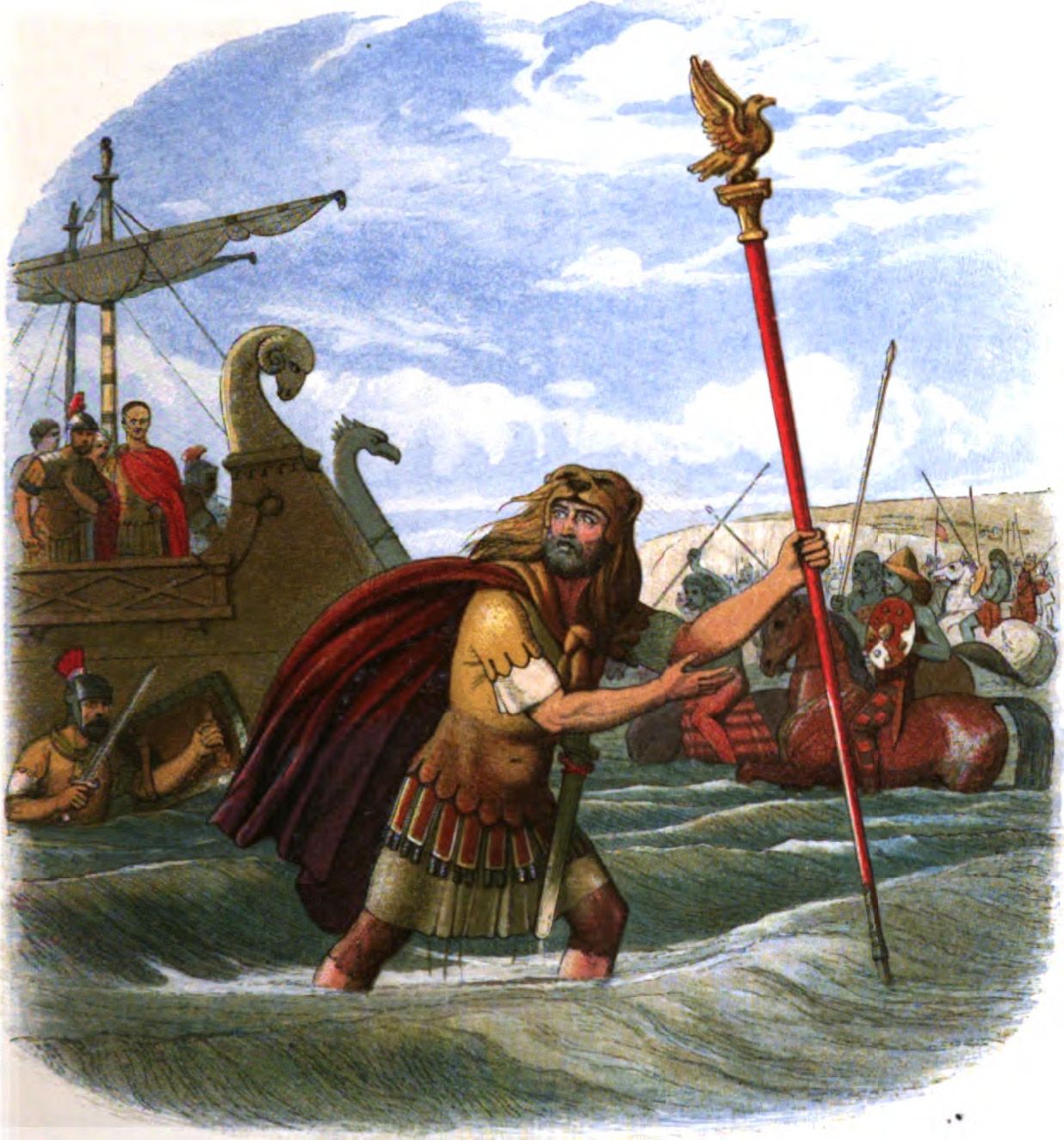
The eagle-bearer Leap down, soldiers, unless you wish to betray your eagle to the enemy;
The eagle-bearer it shall be told that I at any rate did my duty to my country and my general.
In the source
… ‘Leap down, soldiers, unless you wish to betray your eagle to the enemy; it shall be told that I at any rate did my duty to my country and my general.’
In the episode
Julius Caesar Then our troops exhorted one another not to allow so dire a disgrace, and leapt down from the ship with one accord.
In the source
Then our troops exhorted one another not to allow so dire a disgrace, and leapt down from the ship with one accord.
In the episode
Julius Caesar This one thing was lacking to complete the wonted success of Caesar.
In the source
This one thing was lacking to complete the wonted success of Caesar.
In the episode
Julius Caesar That same night, as it chanced, the moon was full, the day of the month which usually makes the highest tides in the Ocean, a fact unknown to our men.
In the source
That same night, as it chanced, the moon was full, the day of the month which usually makes the highest tides in the Ocean, a fact unknown to our men.
In the episode
Julius Caesar a greater dust than usual was to be seen in that quarter to which the legion had marched.
In the source
…
the outposts on duty before the gates of the camp reported to Caesar thata greater dust than usual was to be seen in that quarter to which the legion had marched.
In the episode
Julius Caesar to run along the pole, stand on the yoke, and then, quick as lightning, to dart back into the chariot.
In the source
… to run along the pole, stand on the yoke, and then, quick as lightning, to dart back into the chariot.
In the episode
Julius Caesar the senate decreed a public thanksgiving of twenty days.
In the source
And for these achievements, upon receipt of Caesar's despatches,the senate decreed a public thanksgiving of twenty days.
Caesar, The Gallic War, book 5
The same translation, LacusCurtius.
Also cited
In the episode
Julius Caesar All the Britons, indeed, dye themselves with woad, which produces a blue colour, and makes their appearance in battle more terrible.
Julius Caesar They wear long hair, and shave every part of the body save the head and the upper lip.
In the source
All the Britons, indeed, dye themselves with woad, which produces a blue colour, and makes their appearance in battle more terrible. They wear long hair, and shave every part of the body save the head and the upper lip.
Edmond Halley, "A Discourse tending to prove at what Time and Place Julius Caesar made his first Descent upon Britain"
Philosophical Transactions number 193, reprinted as.
Also cited
In the episode
Edmond Halley the landing on Britain was August 26, in the afternoon,
In the source
… the landing on Britain was August 26, in the afternoon,
about a month before the autumnal equinox…
Cicero, letter to Gaius Trebatius Testa
April or May 54 BC (Letters to Friends 7.7), translated by Evelyn S. Shuckburgh, The Letters of Cicero, volume 1 (London, 1908), letter CXXXVI.
Also cited
In the episode
Cicero In Britain I am told there is no gold or silver.
Cicero If that turns out to be the case, I advise you to capture a war-chariot and hasten back to us at the earliest opportunity.
In the source
In Britain I am told there is no gold or silver. If that turns out to be the case, I advise you to capture a war-chariot and hasten back to us at the earliest opportunity.
Tacitus, Agricola 13
Translated by Alfred John Church and William Jackson Brodribb (1876), Perseus.
In the episode
Tacitus must be regarded as having indicated rather than transmitted the acquisition to future generations.
In the source
… must be regarded as having indicated rather than transmitted the acquisition to future generations.
Where the hosts’ facts come from
Kate, Helen and Will’s facts come from these pages. Open “What it says” to see the lines we used.
The eagle
What it says
- “It is a small shrine and in it perches a golden eagle. It is found in all the enrolled legions”
- “one man carries it on a long shaft, which ends in a sharp spike so that it can be set firmly in the ground.”
Julius Caesar
What it says
- “During the next 9 years Caesar was occupied with the subjugation of Gaul. He conquered the whole of Transalpine Gaul ... he twice crossed the Rhine, and twice landed in …”
- “thus including not only the whole of France and Belgium, but a part of Holland, a great part of Switzerland, and all the provinces of Germany W. of the Rhine.”
The thanksgiving
What it says
- “Supplicatio”
- “SUPPLICATIO was a solemn thanksgiving or supplication to the gods decreed by the senate, when all the temples were opened”
- “it was usually decreed as soon as official intelligence of the victory had been received by a letter from the general in command. The number of days during which it …”
- “and one of fifteen days after the victory over the Belgae by Caesar”
July
What it says
- “Calendarium”
- “Julius was substituted for Quinctilis, the month in which Caesar was born”
- “the calling of one of the months by his name”
The Senate
What it says
- “Senatus”
- “In all the republics of antiquity the government was divided between a senate and a popular assembly”
- “A senate in the early times was always regarded as an assembly of elders”
- “its members were elected from among the nobles of the nation.”
The chariot
What it says
- “Currus”
- “The pole ... It was firmly fixed at its lower extremity to the axle; and at the other end the pole was attached to the yoke”
- “the currus thus constructed was commonly drawn by two horses, which were attached to it by their necks”
- “Jugum”
- “The yoke was in many cases a straight wooden plank or pole laid upon the horses' necks”
Tides
What it says
- “Tides FAQ”
- “Around the UK, there are mostly two high tides and two low tides each day”
- “when the sun and the moon are aligned in space at either new moon or full moon. Spring high tides are higher and spring low tides are lower than average”
- “spring tides occurring between one to two days after new or full moon”
- “Tides around the world”
- “Most people associate the Mediterranean with small tides. However, this is not to say there are no tides at all. Indeed, they generate a mean variation of about 40 centimeters”
- “the Ocean”
Halley's Comet
What it says
- “Sir Edmond Halley”
- “Sir Edmond Halley (1656 - 1742) was an English astronomer”
- “He predicted that the comet would return in 1758; when it was observed as predicted, the comet was named Halley's Comet in his honor.”
What the Britons wrote
What it says
- “Celtic Life in Iron Age Britain”
- “The inhabitants of Iron Age Britain did not leave any written records”
- “Iron Age Kent”
- “In the closing years of the period, and for the first time in history, a written account of the people of Britain was made, by Julius Caesar who landed in …”
What Rome thought, and what came next
What it says
- “First evidence for Julius Caesar's invasion of Britain discovered”
- “It has long been believed that because Caesar returned to France the invasions were failures”
- “The team challenge this notion by suggesting that in Rome the invasions were seen as a great triumph. The fact that Caesar had crossed the sea and gone beyond the …”
- “Almost 100 years after Caesar, in AD 43 the emperor Claudius invaded Britain.”
- “This was the beginning of the permanent Roman occupation of Britain, which included Wales and some of Scotland, and lasted for almost 400 years”
Boudica's hare
What it says
- “When she had finished speaking, she employed a species of divination, letting a hare escape from the fold of her dress”
- “Boadicea, queen of the Iceni in Britain”
- “during the absence of Suetonius Paulinus, the Roman governor”
Tell us what you think of this episode
Will reads every message. Next week’s episodes can change because of what you say, so tell us what you liked, what confused you and what you want to hear about. If you are a child, ask a grown-up to send it.